5 Desk Setup Changes That Fix Afternoon Back Ache
Quick Answer: Afternoon-specific back ache is usually a postural endurance problem, not a setup problem — you hold a good position in the morning and lose it as the supporting muscles fatigue. The five fixes that matter most: raise the screen, support the forearms, change the chair angle, add a movement trigger, and fix the foot position.
At 10am you feel fine.
By 2.30pm there is a band of ache across your mid-back that no amount of sitting up straight resolves.
That timing is the clue, and it points to a different solution than most desk advice offers.

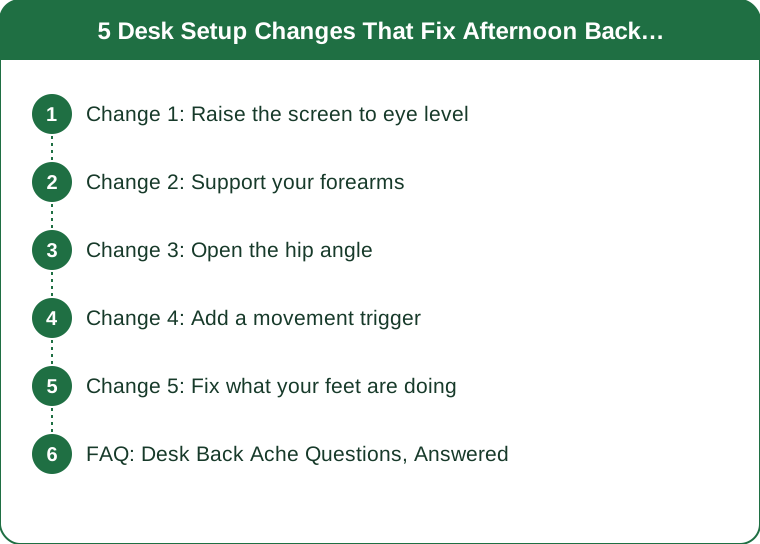
Change 1: Raise the screen to eye level
The single highest-impact change, and the one most home setups get wrong.
The head weighs 4 to 5kg. Held upright over the spine, the supporting muscles do very little. Tilted forward 15 degrees, the effective load on the neck and upper back roughly doubles. At 45 degrees — the angle of a laptop on a desk — it is around four times.
Your morning posture holds against that load. Your afternoon posture does not. That is precisely why the ache is time-dependent: it is a fatigue curve, and the steepness of the curve is set by how much load you put on the muscles in the first place.
The fix: the top of the screen should sit at or just below eye level when you are sitting upright. For a laptop, that means a stand plus a separate keyboard — a laptop alone cannot satisfy both screen height and keyboard height simultaneously.
A stack of books works. A £15 stand works. The specific solution matters far less than the height, and this change alone resolves the afternoon ache for a substantial number of people.
Change 2: Support your forearms
The second-biggest load on the upper back is the weight of your arms, and almost nobody accounts for it.
Two arms weigh roughly 10 percent of bodyweight — about 6 to 7kg for many people. Held unsupported in front of you, that entire load is carried by the upper back and shoulder muscles, continuously, for hours.
The upper trapezius fatigues under sustained low-level contraction faster than most people expect, and the resulting ache sits exactly where the classic afternoon band of discomfort appears.
The fix: get your forearms supported. Armrests adjusted to the correct height — elbows at roughly 90 degrees with shoulders relaxed — do this. So does resting your forearms lightly on the desk edge, provided the desk is at the right height.
The check: sit at your desk, relax completely, and notice whether your shoulders drop. If they drop noticeably, they were holding tension, and that tension is your afternoon ache in slow motion.
Most office chairs have adjustable armrests that nobody has ever adjusted.
Change 3: Open the hip angle
The 90-degree seated position that ergonomics posters recommend is not the most comfortable option for most people over a long day.
Sitting with hips at 90 degrees places the pelvis in a posteriorly tilted position for many people, which flattens the lumbar curve and shifts load onto the passive structures of the spine rather than the muscles. It is fine for twenty minutes. Over six hours it produces a specific low-back ache.
Opening the hip angle to 100 to 110 degrees — by lowering the seat back slightly, tilting the seat pan forward, or simply reclining a little — allows the pelvis to sit more neutrally and restores the lumbar curve without any muscular effort.
Reclining is genuinely good for your back, contrary to the sit-up-straight instruction. A seat back angle of 100 to 110 degrees measurably reduces disc pressure compared with fully upright.
The practical version: recline slightly, keep the screen at eye level so you are not craning forward from the reclined position, and make sure the chair supports your lower back where the curve actually is — usually higher than people set it.

Change 4: Add a movement trigger
No posture is good for six hours. The best-supported finding in this entire area is that changing position frequently matters more than which position you use.
Static loading is what fatigues muscles. A moderately imperfect posture that changes every 25 minutes produces less discomfort than an excellent posture held for three hours.
The fix is a trigger, not a resolution. Intention fails; a physical or calendar prompt does not.
Options that work: standing for every phone call, a timer at 30 minutes, refilling a small water glass rather than a large bottle, standing whenever you read something rather than write it.
The dose: roughly 2 to 3 minutes of standing or walking every 30 minutes. Not a full break — just a change in loading pattern. Even standing up and sitting back down resets the muscles that were holding a static contraction.
If you adopt one habit from this list rather than one purchase, make it this one. It is free, and its effect compounds across a whole working week.
Change 5: Fix what your feet are doing
The most overlooked link, and the one that quietly undoes everything above.
If your feet do not rest flat and supported, your pelvis compensates. Dangling feet pull the pelvis into a posterior tilt. Feet tucked under the chair rotate it. Crossed legs tilt it laterally, and holding that for hours produces a one-sided low-back ache that people usually attribute to something else entirely.
The fix: feet flat on the floor with thighs roughly parallel to the ground, or a footrest if the chair is too high. A ream of paper or a small box works.
The height relationship matters. If your chair is set correctly for your desk, your feet may not reach the floor — that is a footrest problem, not a chair problem. Lowering the chair to reach the floor raises your desk relative to your elbows and creates a shoulder issue instead.
The order to solve it in: desk height sets elbow height, chair height sets desk relationship, footrest fills whatever gap remains. Solving it in any other order produces a compromise somewhere.
FAQ: Desk Back Ache Questions, Answered
Would a standing desk fix this?
Partly. Standing all day produces its own problems, mostly in the legs and low back. The benefit comes from alternating, and a sit-stand desk mostly just makes the movement trigger easier to act on.
How long before changes take effect?
Setup changes often produce a difference within a day or two. If the muscles are already deconditioned, expect two to three weeks of gradual improvement.
When should I see someone about it?
Pain that radiates into a leg or arm, any numbness or tingling, or pain that wakes you at night is worth a proper assessment. This is general information, not medical advice.
TL;DR:
- Afternoon-only ache is a postural endurance problem — the setup is loading muscles that fatigue over hours.
- Raise the screen to eye level and support your forearms — together these remove most of the load.
- Open the hip angle to 100 to 110 degrees; the strict 90-degree posture is not the comfortable one.
- Add a movement trigger every 30 minutes — the single most effective free change available.
- Feet flat and supported, solved after desk and chair height, not before.
Do the screen height first and give it three days. It is the change with the largest effect per unit of effort, and for a lot of people it is the whole answer. This is general information, not medical advice.
Keep Reading
This article is for general informational purposes only and is not medical advice. It is not a substitute for professional diagnosis or treatment. Always consult a qualified healthcare provider about your individual situation, especially before making significant changes to your diet or exercise routine.