Five Two-Minute Resets for the First Week of Dark Commutes Home
Quick Answer: A dark evening commute suppresses the alertness cue that daylight used to provide, so you arrive home flatter than the same journey felt in August. Five short resets — a light exposure fix before you leave, a movement fix on the journey, a temperature fix on arrival, a food-timing fix, and a screen fix — each take about two minutes and target a different part of the problem.
It is the same route, the same length, the same day’s work. And somehow the walk home in late September takes something out of you that the one in July did not.
Here are five short things, in the order the journey happens.

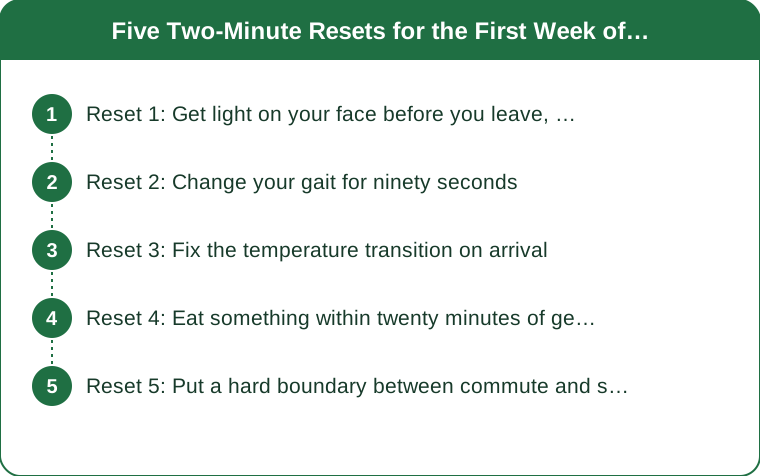
Reset 1: Get light on your face before you leave, not after
The problem starts before the commute does. If you have been under indoor lighting since morning, your body has had very little of the light signal that keeps daytime alertness up.
Indoor office lighting is typically in the range of 300 to 500 lux. An overcast outdoor day is around 1,000 to 10,000 lux, and a bright one is far higher. Those are different orders of magnitude, and the biological systems that respond to light care about the difference.
The reset: two minutes outside, or at a window with the blinds fully open, before you leave the building. Not on your phone. Looking out, at the sky, without sunglasses.
Done at around four or five in the afternoon while there is still daylight, this is meaningfully different from stepping into darkness at six. The window before sunset shrinks by a couple of minutes every day at this time of year, which is precisely why the commute changed character so suddenly.
Why it works: light exposure late in the afternoon supports evening alertness and helps anchor sleep timing. It does not replace morning light, which matters more, but it is the piece most people lose first in autumn.
If you cannot get outside: sit by the brightest window you have for two minutes, facing it. Substantially better than nothing.
Reset 2: Change your gait for ninety seconds
The second thing that changes in autumn is that the commute becomes entirely uniform. Same pace, same surface, coat on, head down, in the dark.
In summer you probably varied it without noticing — you looked around, changed pace, took a different turn, stopped for something. That variety is a low-level physical and mental input, and it disappears when the weather turns.
The reset: ninety seconds of a deliberately different pace somewhere in the middle of the journey.
- Walk fast enough that your breathing changes. Not a run — a pace you could hold a conversation at but would rather not.
- Or take the stairs deliberately rather than the escalator, at a brisk pace.
- Or, if you drive, park two minutes further away and walk that stretch quickly.
Why it works: a short burst of moderate-intensity movement produces a genuine, immediate lift in alertness and mood that outlasts the ninety seconds by a substantial margin. It also breaks the monotony, which is doing more than the physiology in some cases.
The practical trick: attach it to a landmark rather than a timer. The stretch between two specific corners. Timers get ignored; landmarks do not.
Reset 3: Fix the temperature transition on arrival
This is the least obvious of the five and the one people feel most immediately.
Coming in from cold air into a heated house triggers a rapid shift — surface blood vessels dilate, you warm quickly, and there is a distinct wave of sleepiness that arrives about ten minutes after you get in. If you sit down during those ten minutes, that is frequently the end of the evening.
The reset: stay upright and moving for the first two minutes after you get in.
- Do not sit down. This is ninety percent of it.
- Take the coat off, put things away, wash your hands in cool rather than hot water.
- Open a window for sixty seconds if the house is stuffy. A stuffy warm room after a cold walk is the single most sedating environment you will encounter all day.
Why it works: the rapid warming effect is real but short. Bridging it while upright means you come out the other side alert rather than horizontal.
If you have to sit — because there are children, or a dog, or the day was hard — sit somewhere that is not the sofa. A kitchen chair is a genuinely different outcome from an armchair, and nobody plans this and everybody experiences it.
Reset 4: Eat something within twenty minutes of getting in
The dark commute usually lands you home later than the summer version, because you are less inclined to detour and more inclined to go straight back — but it often means the gap since lunch is now six or seven hours.
That gap is what produces the specific evening pattern of feeling flat, then ravenous, then eating a large dinner quickly and feeling heavy.
The reset: something small with protein in it, within twenty minutes of getting in. Not dinner — a bridge.
- A yoghurt, a handful of nuts, a boiled egg, a slice of cheese, a glass of milk.
- Around 10 to 15 grams of protein is enough. This is a signal, not a meal.
- Have it visible and ready. The decision is the barrier, not the eating.
Why it works: it closes the gap that drives the crash, and it takes the edge off the appetite that otherwise determines both the size and the speed of dinner. People who do this consistently report that dinner becomes a smaller, slower, more pleasant event, which is a larger quality-of-life change than it sounds.
What not to do: a large sugary snack. It solves the hunger for twenty minutes and makes the flatness worse.
Reset 5: Put a hard boundary between commute and screen
The last reset is about what happens in the thirty minutes after arrival, and it is the one that determines how the whole evening goes.
The default pattern is: arrive, sit, phone. That combination compresses the transition from work to home into nothing, and the phone specifically prevents the mental gear change from happening at all — you are still processing inputs, just different ones.
The reset: two minutes of something with no screen, immediately on arrival, before the phone comes out.
- Put the kettle on and stand there while it boils. Genuinely effective, requires nothing.
- Change clothes. A physical marker of the transition, and it works better than any mental technique.
- Step outside for a minute, even into a garden or a doorway.
- Put music on — an audio input rather than a visual one, which does not have the same effect on attention.
Why it works: the transition between roles needs a marker, and in the summer the marker was the journey itself, which was pleasant and had things in it. In the dark it becomes a functional transit that provides no boundary. Rebuilding a small deliberate one restores what the season removed.
The two minutes is the point. Not a routine, not a ritual, not something to fail at. Two minutes, one thing, no screen.
FAQ: Dark Commute Questions, Answered
Why does this hit so suddenly rather than gradually?
Because the sunset time is moving quickly at this point in the year — several minutes a day at northern latitudes — and because there is usually one specific week where your journey home crosses from light to dark. It is a gradual astronomical change producing an abrupt experiential one.
Would a light therapy lamp help?
Possibly, particularly if you also lose morning light. They are generally used in the morning rather than the evening, since bright light late in the day can shift sleep timing later. If low mood in autumn and winter is significant or recurring, that is worth discussing with a doctor rather than self-treating. This is general information, not medical advice.
Which of the five matters most?
If you only do one, do the second one — the ninety seconds of faster movement. It is free, it works immediately, and it is the one that most reliably changes how you feel on arrival.
TL;DR:
- Two minutes of daylight before you leave, at a window or outside, while there is still light to get.
- Ninety seconds of a faster pace mid-journey, attached to a landmark rather than a timer.
- Stay upright for two minutes on arrival. The warming wave is what ends evenings.
- Eat 10 to 15 grams of protein within twenty minutes to close a six-hour gap since lunch.
- Two minutes with no screen before the phone. The commute used to be the boundary; in the dark it stops being one.
Same route, different season. Five short fixes, one for each part of it. This is general information, not medical advice.
Keep Reading
This article is for general informational purposes only and is not medical advice. It is not a substitute for professional diagnosis or treatment. Always consult a qualified healthcare provider about your individual situation, especially before making significant changes to your diet or exercise routine.